

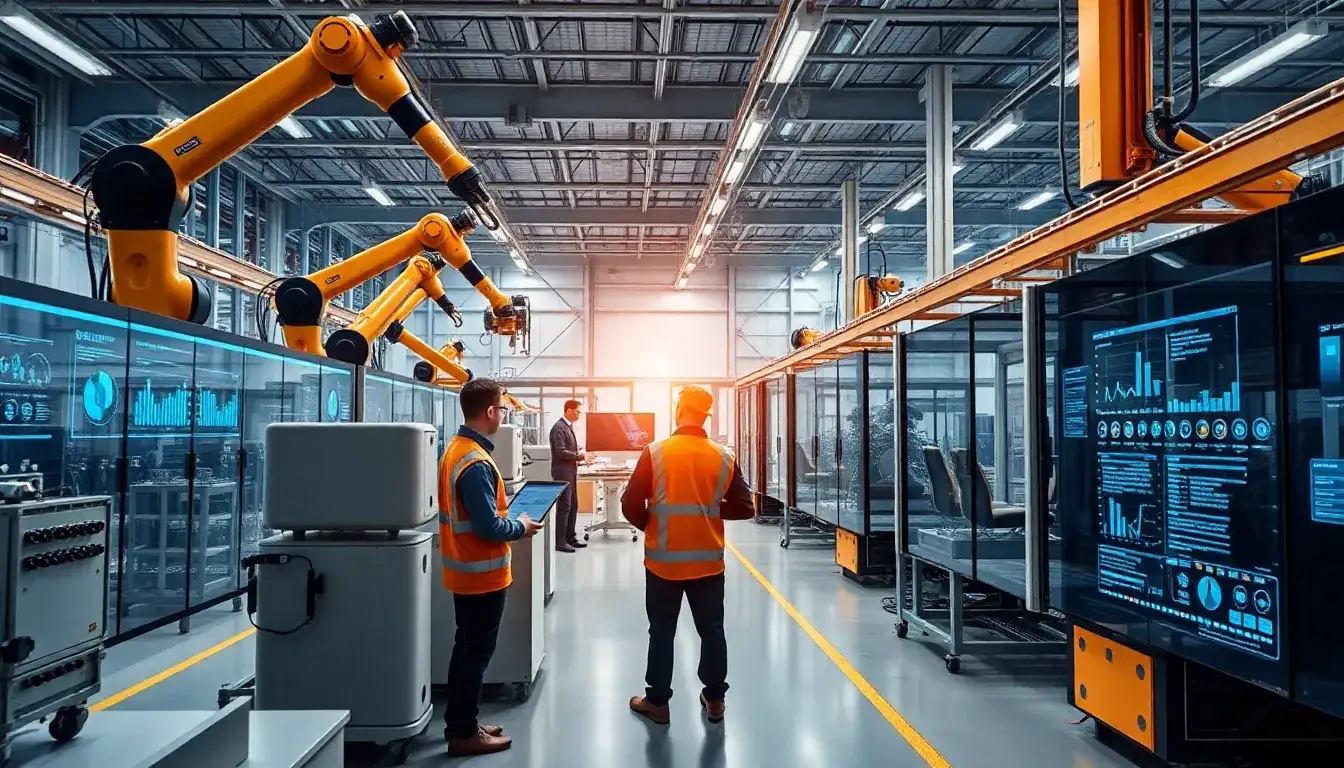
2025 World Cutting-Edge Technology Development Report: Intelligent Manufacturing Technology Development (Part 2)
1. Industrial Robots
1.1. Growing Market Size for Industrial Robots
With the advancement of intelligent manufacturing, industrial robots have become an essential part of industrial settings, playing an increasingly significant role in production processes. The market size continues to expand.
China, Japan, the United States, South Korea, and Germany are the top five robot markets globally.
In Asia, China stands out as the largest industrial robot market in the world.
- By 2023, China’s industrial robot stock reached approximately 1.8 million units, making it the first and only country with such a vast number of industrial robots.
Japan remains the second-largest market for industrial robots, following China.
South Korea ranks as the fourth-largest robot market, behind China, Japan, and the United States.
In Europe, the installation of industrial robots in 2023 grew by 9% year-on-year, reaching a record high of 92,000 units.
In the Americas, the installation of industrial robots has exceeded 50,000 units for the third consecutive year.
1.2. Increasing Intelligence Level of Industrial Robots
Traditionally, industrial robots are defined as multi-joint mechanical arms or multi-degree-of-freedom devices used in industrial applications, featuring a degree of automation. They can rely on their own power and control capabilities to perform various manufacturing functions.
Depending on their form, they can be categorized into six-axis robots, SCARA robots (Selective Compliance Assembly Robot Arm), Delta robots, collaborative robots, and more.
- Six-axis robots are the largest category by shipment volume, characterized by high technological barriers. They are further divided into large and small six-axis robots based on their load capacity. These robots are equipped with high-torque actuators and precision control systems, prioritizing speed, precision, and load capacity, typically deployed in heavy industrial scenarios requiring high throughput.
- Traditional industrial robots lack adaptability.
1.3. Expanding Capabilities of Industrial Robots
With the deepening application of the Internet of Things, new sensing and recognition solutions, as well as the rapid introduction of new technologies such as artificial intelligence and machine learning, the capabilities of industrial robots are expanding.
Through self-learning and optimization, industrial robots can handle complex tasks, improving operational efficiency and accuracy, with their autonomous capabilities continuously enhancing.
1.4. Collaborative Robots
Collaborative robots, viewed as solutions for human-machine coexistence and interaction, can enhance the automation level of factories.
These robots resemble industrial robots but are smaller, sacrificing some load capacity for higher safety (by adding safety hardware), flexibility, and programmability. Equipped with force-torque sensors for collision detection and auxiliary vision sensors for environmental perception, they can be quickly redeployed within factories as needed.
Some collaborative robots are already equipped with advanced AI capabilities, enabling them to perform tasks such as variable grasping and sorting.
Collaborative robots typically handle low-intensity, high-precision tasks, such as processing lightweight materials between factory processes, loading raw materials into CNC machines, retrieving finished products, and performing quality inspections.
1.5. Autonomous Mobile Robots (AMRs)
AMRs represent the latest members of the automation robotics field, utilizing mobility to perform transportation tasks and enabling multi-robot collaboration.
- Types include Automated Guided Vehicles (AGVs), Mobile Manipulator Robots, Quadruped Robots, and Humanoid Robots.
- AGVs, which emerged alongside collaborative robots, feature relatively simple core functions and are well-established in applications, ranging from heavy-duty container AGVs with load capacities of several tons to customized AGVs in factories with weights in the hundreds of kilograms.
- Mobile Manipulator Robots consist of a mobile base, a robotic arm, and an end effector, often featuring wheel-based structures that provide mobility. These robots have been applied in factories and healthcare, showcasing significant potential in civil applications such as food service, home assistance, and delivery, as well as in military operations.
- Quadruped robots are primarily used for factory inspections and load transportation, with ongoing improvements in flexibility and functionality.
- As technology matures and costs decrease, consumer-grade quadruped robots are increasingly targeted at home companionship, educational entertainment, and health monitoring.
1.6. Humanoid Robots
Particularly, “Embodied Intelligent Industrial Robots” (EIIR) stand out with features of “embodied intelligence + humanoid + industrial.”
Humanoid robots, with their human-like structure and brain-like cognition, offer higher degrees of freedom and task diversity. They can adapt to a broader range of industrial scenarios, exhibiting advanced skills such as grasping any object, tool usage, and flexible object handling. They are considered the ultimate form in industrial production, coexisting with humans or potentially replacing them.
With rapid advancements in humanoid robot technologies, including their “brain” and “body,” industrial applications are entering deployment exploration stages.
- The Optimus robot has tested sorting battery cells and transporting 20 kg automotive parts.
- Amazon has introduced Digit, a humanoid robot from Agility Robotics, in its smart distribution centers to assist employees in handling tasks.
- Apptronik has partnered with logistics provider GXO to deploy Apollo humanoid robots in GXO warehouses for various tasks such as handling, picking, and scanning.
- Dongfeng Liuzhou Motor Co., Ltd. employs Walker S, an industrial humanoid robot from UBTECH, in tasks like body quality inspection, interior assembly checks, and fluid refills during automotive manufacturing.
1.7. Impact and Insights
Traditional industrial robots have proven to yield good returns on investment for repetitive tasks.
In the long run, with the shift towards flexible and variable industrial production modes, industrial robots must possess a certain degree of adaptability for product changeovers and process adjustments. This requires traditional industrial robots to enhance their integration and customization capabilities while maintaining cost advantages.
The intelligence of new industrial robots needs to not only execute commands efficiently but also proactively engage in industrial production activities, such as autonomously perceiving and analyzing production environments, identifying bottlenecks in processes, and suggesting feasible optimizations through continuous self-learning.
As the largest industrial robot market globally, China faces both opportunities and challenges.
- The increasing total number of industrial robots and the market share of domestic manufacturers indicates strengthening capabilities in independent research and development.
- However, in core components such as reducers, servo motors, and sensors, there remains some reliance on companies from the U.S., Europe, and Japan, such as HarmonicDrive from Japan and Siemens from Germany.
- There are still gaps in precision, stability, load capacity, and production process optimization compared to international advanced levels, particularly highlighted in the context of intensified international competition.
Strengthening the technology level of key components and enhancing independent innovation capabilities remain focal points for the development of China’s industrial robots.
In the wave of intelligent transformation, government departments should continue to guide policies, strengthen innovation collaboration within the industrial robot industry and new technologies, leverage China’s advantages in new technology fields, enhance the competency of industrial robots, increase the domestic rate of industrial robot software and hardware, and explore new demands and innovative application scenarios using China’s vast market advantage.
Government departments should take a more forward-looking approach, building a development roadmap for the industry, providing financial support for the deployment of new industrial robots, and enhancing interdisciplinary high-end talent cultivation to propel the industrial robot industry forward, achieving a historic breakthrough from large-scale to strong capability.
2. New-Type Factories
2.1. Increasing Number of New-Type Factories Driving Manufacturing Transformation
2.2. Lighthouse Factories
Lighthouse factories serve as the most advanced global manufacturing facilities, utilizing innovative technologies such as artificial intelligence, 3D printing, and big data analysis to enhance efficiency, boost competitiveness, and drive large-scale transformations in business models. They are viewed as exemplars of digital intelligent manufacturing and deep applications of the industrial internet, providing models for other manufacturing enterprises embarking on digital transformation.
2.2.1. Sustainable Lighthouses
Since their initial selection in September 2021, “Sustainability Lighthouses” have recognized leaders in carbon reduction and circular economy practices, referred to as “lighthouses among lighthouses,” with 20 facilities awarded to date.
- Foxconn has utilized AI, IoT, and other Fourth Industrial Revolution technologies to optimize material recycling, track real-time carbon footprints, and innovate processes for sustainable development, reducing Scope 3 emissions by 42% and Scope 1 and Scope 2 emissions by 24%, while increasing the proportion of recyclable materials to 55-75%.
- Midea’s washing machine factory, operational since May 2007, features 11 production lines with an annual capacity of 16 million units, making it the largest comprehensive washing machine manufacturing base in China.
- The factory has deeply integrated AI across all processes, covering 457 sub-scenes, resulting in a 25% reduction in development cycles, a 37.6% decrease in energy consumption, and a 29% optimization in logistics paths.
- Qingdao Beer, a traditional brewery, has become the world’s first “Sustainable Lighthouse Factory” in the food and beverage sector, utilizing advanced algorithms and IoT to deploy 25 use cases aimed at reducing energy consumption and carbon intensity in beer production, achieving a 25% reduction in unit energy consumption, a 57% decrease in Scope 1 and Scope 2 emissions, and a 13% reduction in Scope 3 emissions.
2.2.2. Single Factory Lighthouses
Single Factory Lighthouses provide a roadmap for accelerating the deployment of AI solutions that enhance production efficiency, problem-solving capabilities, and innovation.
2.2.3. End-to-End Lighthouses
End-to-End Lighthouses focus not only on the factory itself but also on the upstream and downstream processes.
- Factories and their supply chains have widely deployed new technologies, improving process transparency while streamlining complex workflows and enhancing design and planning efficiency.
- Haier’s air conditioning facility in Jiaozhou has optimized its entire value chain through big data, advanced algorithms, and generative AI, reducing design cycles by 49%, order delivery times by 19%, and lowering failure rates in overseas markets by 28%.
- Schneider Electric has increased automation levels by 20% and integrated various advanced technologies, including machine learning-driven prototype design and intelligent planning, resulting in a 63% faster product launch speed, a 67% decrease in delivery times for made-to-order production, and an 82% improvement in labor productivity.
2.3. Smart Factories
Smart factories are modern facilities that integrate advanced information technology, automation, and artificial intelligence to optimize production processes and management. They enhance production efficiency, reduce costs, and improve product quality and flexibility, thereby strengthening market competitiveness.
As a core area of intelligent manufacturing, the integration of IoT, big data, and AI enables the automation, digitization, and intelligence of production processes, playing a vital role in driving the manufacturing industry towards greater efficiency, intelligence, and sustainability.
The development of smart factories is rapidly advancing, driven by policy guidance and technological iterations, achieving new heights in the “basic-advanced-excellent-pioneering” framework across various sectors, including automotive, steel, home appliances, pharmaceuticals, and new energy.
2.4. Impact and Insights
Lighthouse factories and smart factories have profound significance for the global manufacturing industry. Their distinct features reflect the deep integration of intelligence, digitalization, and sustainability, playing an irreplaceable leading role in promoting the transformation and upgrading of the manufacturing sector and achieving sustainable development.
In terms of intelligence, factories have realized real-time interconnectivity and efficient collaboration between equipment and systems, greatly enhancing production efficiency and resource utilization.
Through big data analysis and predictive maintenance technologies, factories can dynamically optimize production processes, proactively identify and address potential failures, significantly reducing downtime caused by equipment malfunctions, thereby further improving overall operational efficiency and stability.
Regarding digitalization, the core advantage of Lighthouse Factories lies in their data-driven decision-making capabilities.
By integrating cloud computing and blockchain technologies, Lighthouse Factories have established a transparent, efficient, and secure production management platform, significantly enhancing the flow of supply chain information and operational efficiency while providing robust safeguards for data privacy and system security, further solidifying the technological foundation of intelligent manufacturing.
In terms of sustainable development, Lighthouse Factories utilize smart grids, green energy, and waste recycling technologies, along with real-time data monitoring and intelligent control systems, to effectively reduce energy consumption and carbon emissions, achieving efficient resource utilization and providing technical support and practical examples for carbon neutrality goals.
As global attention to sustainable development grows, Lighthouse Factories will continue to advance in areas such as green energy applications, energy-saving upgrades, and resource recycling.
Companies often face challenges such as a lack of unified technical systems and equipment standards, incompatible interfaces, and differences in data formats and communication protocols when constructing and operating Lighthouse Factories.
It is recommended that governments and industry associations lead the development of unified technical standards and norms to promote cross-platform and cross-supplier system integration, enhancing overall technical interoperability and collaborative efficiency.
The construction and operation of these factories place high demands on talent, with the current talent shortage becoming a key factor limiting development.
- It is advisable for companies to collaborate with universities and research institutions to establish specialized training programs and industry-academia-research bases to cultivate composite talents who understand manufacturing processes and are proficient in digital technologies.
- Attracting high-end overseas talent can be achieved by optimizing salary and benefits packages and career advancement pathways.
To address the rapid pace of technological updates and high R&D costs, increased investment in new technology research and development is recommended, encouraging collaboration between companies and research institutions to tackle core technologies such as industrial IoT, big data analytics, and AI applications.
By establishing joint laboratories and technology-sharing platforms, resources can be shared to reduce research and development costs and improve innovation success rates.
Original article by NenPower, If reposted, please credit the source: https://nenpower.com/blog/advancements-in-smart-manufacturing-technologies-insights-from-the-2025-global-frontier-technology-development-report/

