

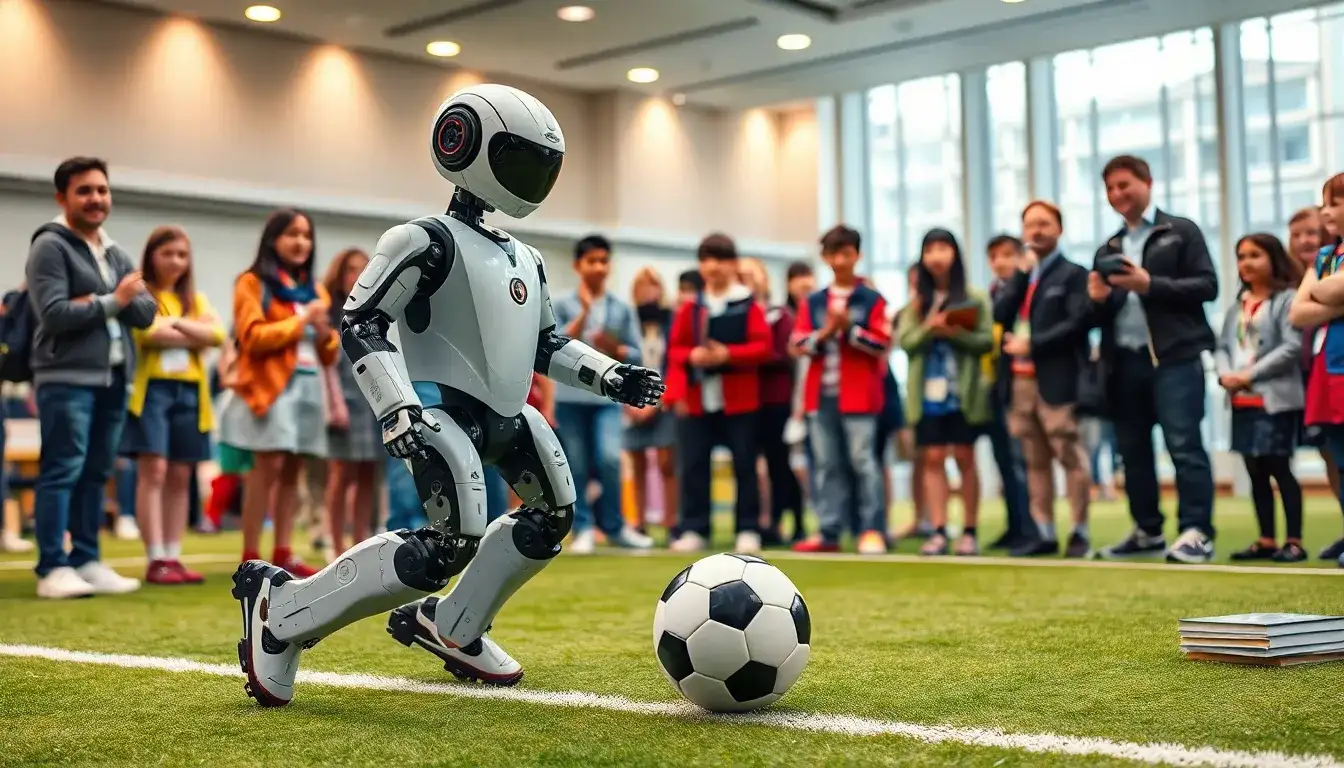
In February 2026, the “Football Intelligence” program announced the release of the first version of its educational-grade football robot. This robot, designed for use in educational institutions, aims to integrate various elements of robotic technology to address multiple engineering challenges. Over the past six months, the project team has worked diligently to overcome numerous technical obstacles and finalize the initial design objectives.
Following the completion of the concept model in August 2025, the team confirmed the technical direction, utilizing the ESP32 as the primary control chip, STS3032 servo motors for movement, and the MPU6050 sensor for motion detection. The implementation of PID control algorithms enables precise movement regulation.
During testing, the robot demonstrated stable performance; however, issues arose concerning its ability to maintain a fixed position. Initially, the PID parameters were set to high values, resulting in excessive motor oscillation when the robot was placed on a flat surface. The team revised the sensor parameters and adjusted the system’s feedback loop, which improved stability, achieving a control angle precision of ±1 degree.
In terms of mobility, the robot can traverse flat surfaces effectively, but challenges emerged when it encountered obstacles or uneven terrain, leading to failures in its adaptive control capabilities. Continuous adjustments to the motor output settings and feedback loops improved its performance under these conditions.
To further enhance its operational capabilities, the team redesigned the electronic circuits, incorporating filtering networks to improve stability following three rounds of testing. The current prototype has successfully validated essential functions such as rolling and hopping, and features a wireless control system for mobility adjustments.
With the initial version of the product now operational, the team is focusing on enhancing dynamic performance and reliability to meet design specifications. Future iterations will aim to refine the control algorithms and improve the robot’s adaptability to various environments.
This project represents a significant step in applying robotics to educational settings, allowing students to engage with technology in innovative ways. The “Football Intelligence” program is committed to advancing this technology further, ensuring that it meets the needs of educational institutions and enriches the learning experience.
Original article by NenPower, If reposted, please credit the source: https://nenpower.com/blog/advancements-in-robotics-launch-of-the-first-educational-soccer-robot-soccer-intelligence/

