

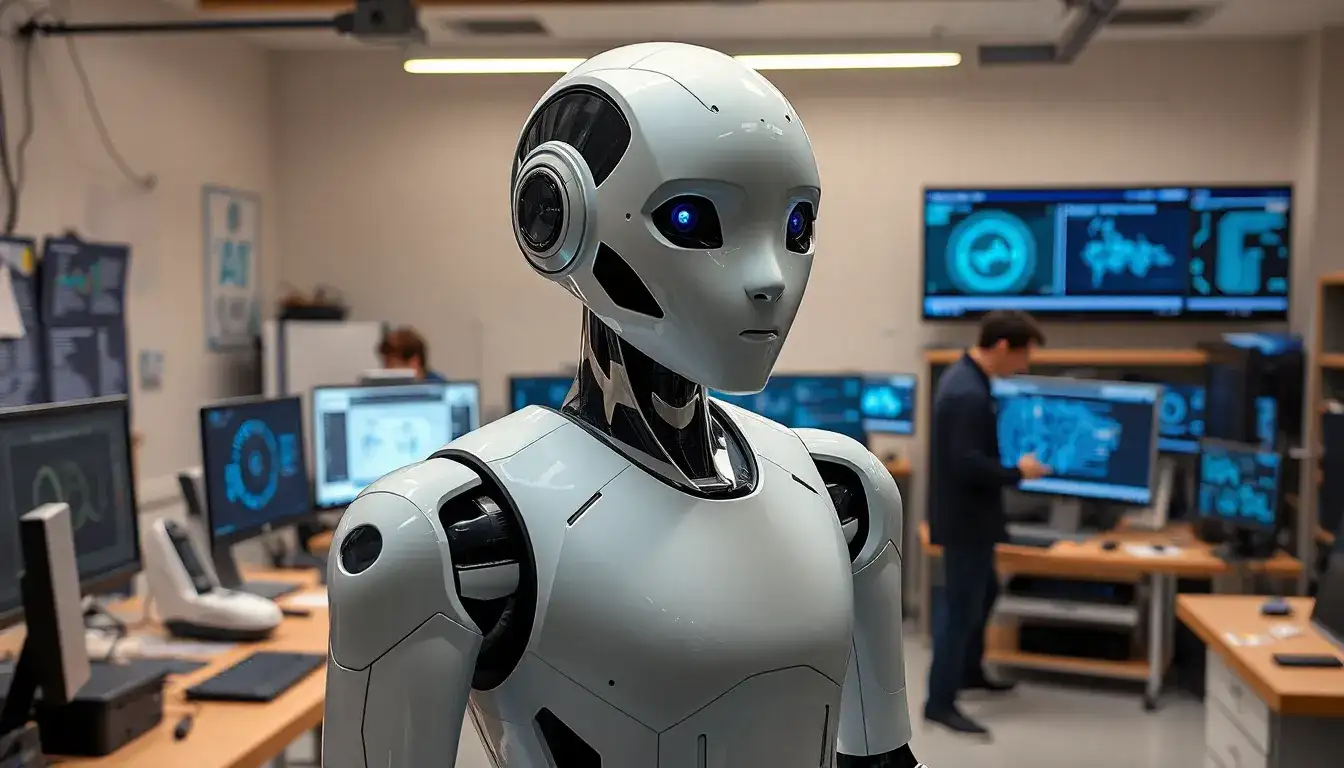
Humanoid Robots and True Machine Learning! ICLR 2026 introduces breakthroughs in humanoid robot training, focusing on real-world simulation and efficient methods.
On February 7, 2026, new advancements were presented regarding humanoid robots and their training methodologies, emphasizing the importance of true machine learning in this field.
Currently, humanoid robots have already demonstrated capabilities such as jumping, running, and even navigating complex environments. However, a critical challenge that remains is whether these systems can consistently perform well after being deployed in real-world settings. The main focus now is on ensuring that these systems can maintain robust learning and adaptation even when faced with unpredictable variables—essentially bridging the gap between simulated environments and real-life application.
The ongoing research indicates that large-scale training methods can lead to greater stability and adaptability, especially in environments that require constant adjustments and improvements. The primary focus remains on optimizing the Sim2Real pathway, where simulations need to be effectively translated into real-world performance.
This new approach, termed LIFT (Large-Scale Pretraining and Efficient Fine-Tuning), is designed to enhance the training and adaptation of humanoid robots. LIFT builds upon three core principles:
- Scalability: Utilizing techniques like SAC (Soft Actor-Critic) over PPO (Proximal Policy Optimization) to enhance the handling of various training data and scenarios.
- Robustness: Ensuring that the training models are resilient against variability in data and environment, allowing humanoid robots to handle unexpected challenges.
- Efficiency: Implementing advanced reinforcement learning strategies that can effectively utilize real-world data to refine the robot’s learning algorithms.
In real-world applications, the humanoid robot’s primary function is to execute precise actions while being adaptable to various conditions. The integration of physics-informed models into the training framework has shown promise, allowing for enhanced performance in complex environments.
Through experiments conducted on humanoid robots like Booster T1 and Unitree G1, LIFT has demonstrated significant advantages over traditional training methods. For instance, LIFT has achieved faster training times and improved performance metrics compared to baseline methods such as PPO and SAC.
As we move forward, the focus will be on refining these training methodologies to create systems capable of continuous learning and adaptation. This involves leveraging existing data to enhance the training process and ensuring that learning remains stable and efficient.
In conclusion, the advancements in humanoid robot training and machine learning methodologies are paving the way for a more efficient and capable future for humanoid robotics. The work being done today is crucial in establishing a solid foundation for the intelligent robots of tomorrow.
For further details, please visit the LIFT project page or access the original research paper.
Original article by NenPower, If reposted, please credit the source: https://nenpower.com/blog/advancements-in-humanoid-robots-bridging-large-scale-pretraining-and-effective-fine-tuning-techniques-for-enhanced-learning-at-iclr-2026/

