

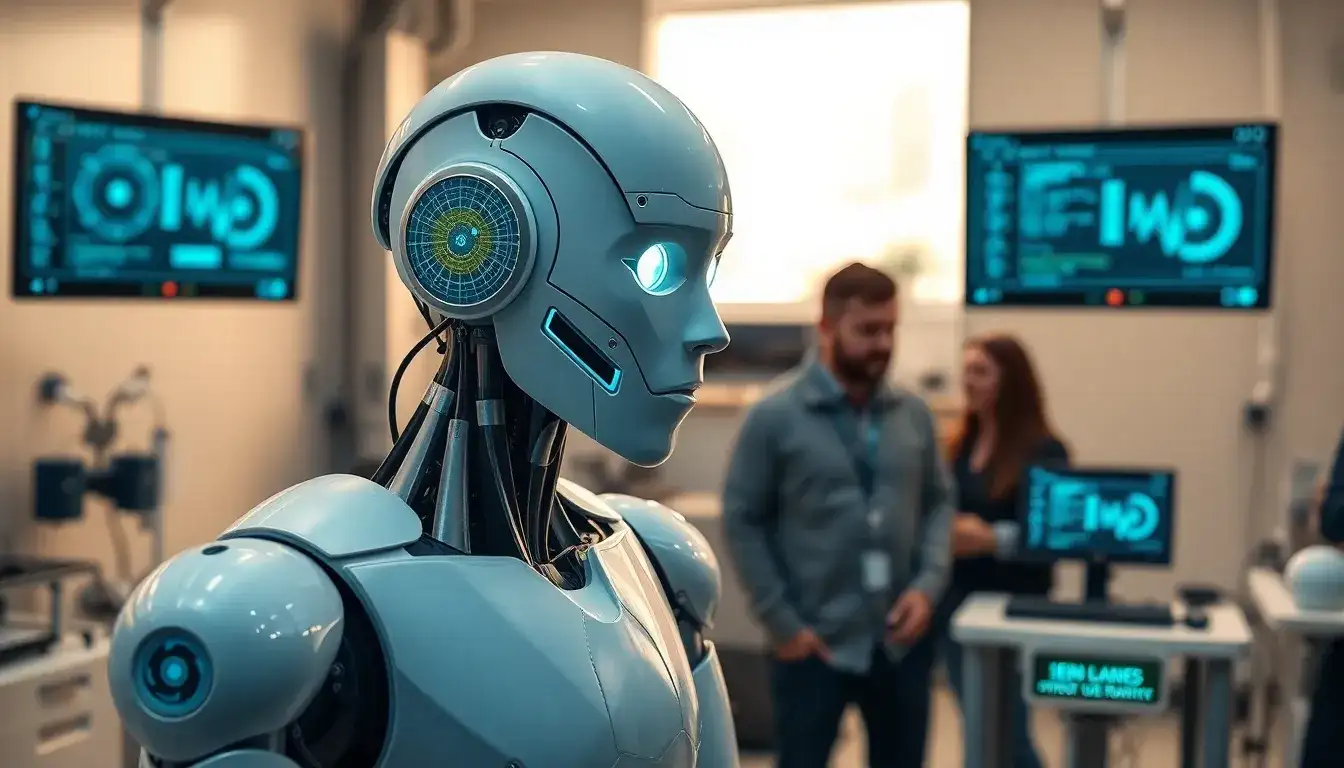
Humanoid Robots’ True Machine Learning Power! The ICLR 2026 conference has announced the release of a paper detailing humanoid robot training and true machine micro-adjustment capabilities.
On February 7, 2026, at 15:00, the Machine Learning Core Pro application revealed new features for humanoid robots. These robots have already demonstrated capabilities such as jumping, running, and performing various tasks in real-world scenarios. However, a pressing question remains: can these systems continue to successfully operate after their initial deployment?
In a world increasingly focused on stability and adaptability, it is essential to consider how these systems can continue to learn and improve in dynamic environments. The current mainstream approach is still heavily reliant on the Sim2Real pathway, which suggests that “learning from simulation to reality is quite robust, but real-world applications can be challenging due to unknown variations in the environment,” including factors like payload, balance, and configuration.
Recent advancements from the LIFT framework have introduced an innovative pathway: LIFT (Large-Scale Pretraining and Efficient Fine-Tuning). This framework employs off-policy reinforcement learning methods such as Soft Actor-Critic (SAC) to execute large-scale simulations and subsequently improve the training process by focusing on physics-informed models.
As these robots primarily operate in environments that require stability and adaptability, they face challenges in ensuring safety and reliability. The approach involves using limited data efficiently while maintaining performance. By harnessing data from large-scale pretraining, the LIFT framework aims to enhance the robustness of humanoid robots in real-world settings.
In comparative studies, models trained using LIFT have shown significant improvements in various tasks. For instance, in the MuJoCo Playground, LIFT’s pretraining methods led to faster convergence times compared to traditional methods like PPO and FastTD3. The LIFT framework’s innovative strategies allow for direct integration of simulated experiences into real-world applications, making it a promising solution for ongoing development in machine learning for humanoid robots.
Conclusively, as technology evolves, ensuring that humanoid robots can learn from their environments and adapt effectively will be crucial for their future applications. The LIFT framework represents a significant step towards achieving this goal, providing a pathway for more efficient and effective machine learning processes in humanoid robotics.
For further reading on this topic, you can access the research paper and explore the GitHub repository for more details on LIFT and its applications in humanoid robotics.
Original article by NenPower, If reposted, please credit the source: https://nenpower.com/blog/advancements-in-humanoid-robot-learning-iclr-2026-highlights-on-efficient-training-and-fine-tuning-techniques/

