

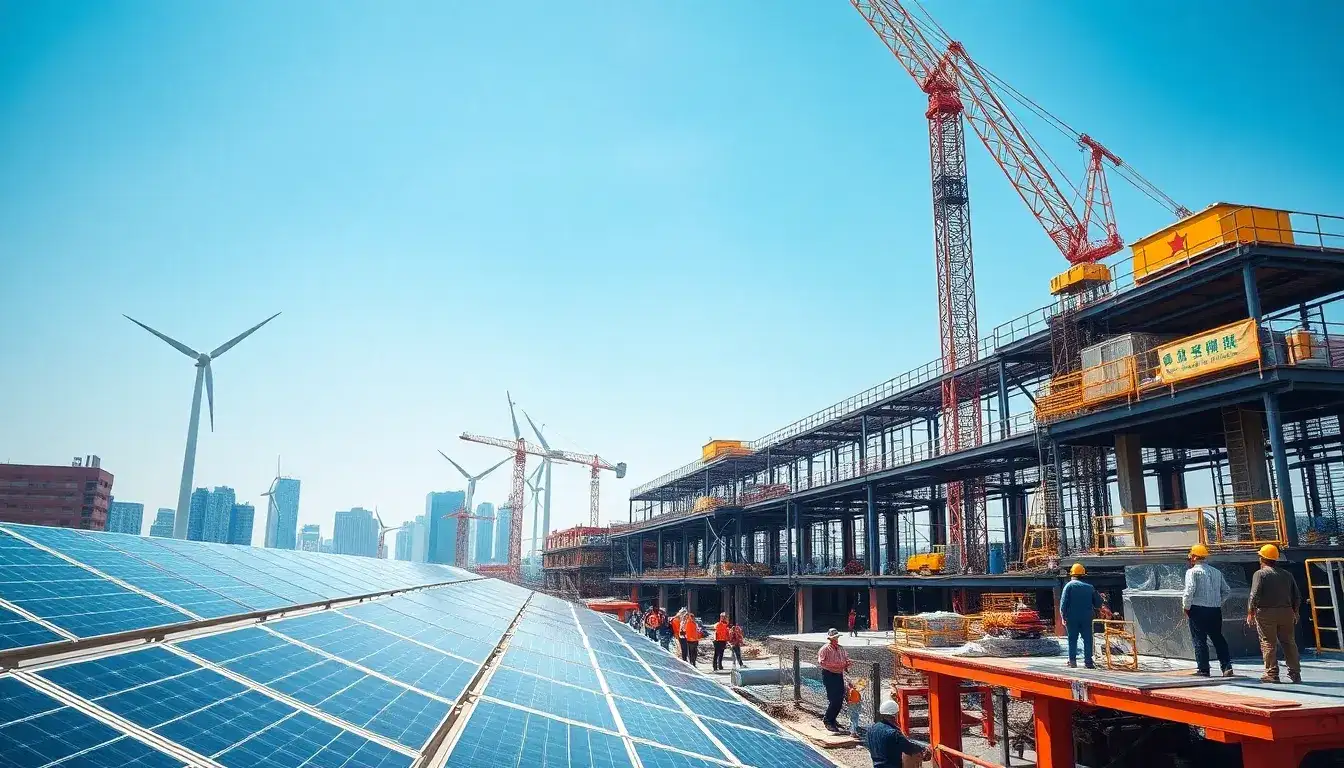
As the “14th Five-Year Plan” reaches a critical juncture, the construction of a new energy power system is rapidly advancing. Recently, several major projects have been successfully completed, including the commissioning of the second phase expansion of the Qinghai-Tibet interconnected grid, known as the “Electric Power Highway,” and the successful power delivery from the country’s largest capacity “air battery.” These developments mark significant progress in the construction of China’s new energy power system.
In line with the new round of national self-contribution goals, China aims to achieve a total installed capacity of 3.6 billion kilowatts for wind and solar power by 2035. The high proportion of renewable energy integration presents greater demands for the establishment of a new energy power system. Reports indicate that achieving breakthroughs in this area is a top priority for energy transition efforts during the “14th Five-Year Plan.” Relevant departments are set to scientifically plan and implement a series of major strategic tasks, projects, and reform measures, while enterprises are also ramping up their investments and collaboration.
In the northwest region, numerous transmission towers and lines crisscross the landscape. On September 28, the Qinghai-Tibet interconnected grid’s second phase expansion was officially put into operation, doubling the transmission capacity between Qinghai and Tibet to 1.2 million kilowatts. This enhancement will enable an annual transfer of 2.1 billion kilowatt-hours of green electricity from Tibet. During winter, the incoming electricity will meet 35% of the region’s total power consumption, significantly bolstering Tibet’s power supply capability.
Meanwhile, in the heart of the Yangtze River Delta, the country’s largest compressed air energy storage power station—the Huaneng Jintan Salt Cavity Compressed Air Energy Storage Project—has also successfully commenced operations. If both units are fully operational, they can store 2.8 million kilowatt-hours of electricity in a single charge, sufficient to meet the charging needs of 100,000 electric vehicles. Furthermore, this project can serve as a “super energy regulator” for the power grid in the Yangtze River Delta, with one unit capable of providing peak regulation capacity of 350,000 kilowatts for Jiangsu Province.
In recent years, China has accelerated the construction of a new energy power system, optimizing its energy structure and continuously introducing landmark projects and innovative achievements. The country has achieved its goal of a total installed capacity of 1.2 billion kilowatts for wind and solar power, six years ahead of the 2030 target. According to the latest data from the National Energy Administration, as of the end of August this year, the national cumulative installed power generation capacity reached 3.69 billion kilowatts, reflecting an 18% year-on-year increase. Among this, the capacity for solar power reached 1.12 billion kilowatts, a remarkable 48.5% increase, while wind power capacity totaled 580 million kilowatts, up by 22.1%.
Recently, China announced a new round of national self-contribution goals. These include targets for non-fossil fuel energy consumption to account for over 30% of total energy consumption by 2035, and a total installed capacity for wind and solar power to exceed six times that of 2020, striving to reach 3.6 billion kilowatts. “These new goals are a scientific response to China’s energy transition strategy,” stated Li Sheng, Secretary of the Party Committee and President of the China Institute of Water Resources and Hydropower Research. He noted that China’s economy is expected to continue its stable growth in the long term, with increasing energy demands across industries, construction, and transportation, alongside the expanding adoption of digital technologies driving the rapid growth of emerging energy demands like data centers and computational infrastructure.
After reaching peak carbon emissions before 2030, achieving the goal of having non-fossil energy consumption exceed 80% by 2060 will require further consolidation of renewable energy’s primary position in the growth of energy consumption. Yang Kun, Secretary of the Party Committee and Executive Vice Chairman of the China Electric Power Enterprise Federation, emphasized that as the pace of the clean and low-carbon energy transition accelerates and the proportion of renewable energy increases, it is gradually becoming the main power source. This trend highlights the dual peak characteristics of the power system, revealing deficiencies in system regulation capabilities, unpredictable load demands, and an exponentially increasing difficulty in balancing electrical supply and demand, thereby raising the safety and reliability requirements for the power system.
The “14th Five-Year Plan” period is a crucial five years for advancing the construction of a new energy power system. The National Energy Administration aims to leverage this strategic period to accelerate the construction of a new energy power system, focusing on high-quality development within the power industry, while coordinating all aspects from sources and grids to loads and storage. The plan includes scientific planning and implementation of major strategic tasks, key projects, and reform measures to drive new breakthroughs in the construction of the new energy power system.
Related enterprises are also hastening their preparations. Wen Shugang, Chairman of China Huaneng Group, stated that during the “14th Five-Year Plan,” the company’s new energy installed capacity has historically surpassed 100 million kilowatts, achieving a fourfold increase in five years. The “15th Five-Year Plan” will push forward the construction of large-scale bases, promote deep-sea offshore wind power development, and facilitate cooperation among electricity, carbon, hydrogen, and heat to meet the entire society’s energy needs with clean energy.
As the power generation side becomes greener, the power grid must also enhance its resilience. Pang Xiaogang, General Manager of the State Grid Corporation of China, disclosed that over the past five years, the company has invested an average of 574 billion yuan annually, with projected investments reaching 677 billion yuan by 2025. It is anticipated that average annual investments in the power grid during the “15th Five-Year Plan” will further increase above the elevated levels of the “14th Five-Year Plan.”
Technological innovation is a key support for constructing a new energy power system. Looking toward the “15th Five-Year Plan,” the State Grid Corporation will focus on advanced electrical materials and high-end power equipment, major electrical equipment, digital and intelligent operations, and the planning and operational theory of new energy power systems. They will collaborate on addressing foundational theories and core technologies, vigorously advance crucial components and essential application software, and accelerate the pace of domestic substitution for critical technologies.
A unified national electricity market is vital for constructing a new energy power system. Xu Shubiao, General Manager of the State Power Investment Corporation, remarked that building a new energy power system is not only a technical issue but also involves economic systems and mechanism design. It requires collaborative efforts across technological innovation, pricing mechanisms, policy systems, and market rules to ensure the healthy and sustainable development of the entire energy industry chain, thereby ensuring a stable and far-reaching energy transition.
Original article by NenPower, If reposted, please credit the source: https://nenpower.com/blog/accelerating-the-construction-of-a-new-power-system-during-the-14th-five-year-plan-in-china/

