

Abandoned Salt Caverns Transform into “Super Power Banks” as Compressed Air Energy Storage Attracts Investment Surge
Compressed air energy storage (CAES) can be simply described as “storing air during low electricity demand and generating power during peak demand.” In recent years, CAES has emerged as a promising large-scale physical energy storage technology, becoming a focal point for research and investment in the energy sector. Currently, the industry is experiencing a critical phase of technological breakthroughs and large-scale applications.
“In the past two years, the cost of compressed air energy storage has decreased rapidly, and its lifecycle costs now have a competitive edge over electrochemical storage,” stated a representative from China Power Construction Corporation (CPCC). Recently, reporters from the Securities Times explored the CAES project in the abandoned salt caverns of Feicheng, Shandong Province, and discovered that with multiple supports from policies and applications, the overall performance and economic viability of CAES are continually improving, marking a new developmental phase for the industry.
Repurposing Abandoned Mine Caverns
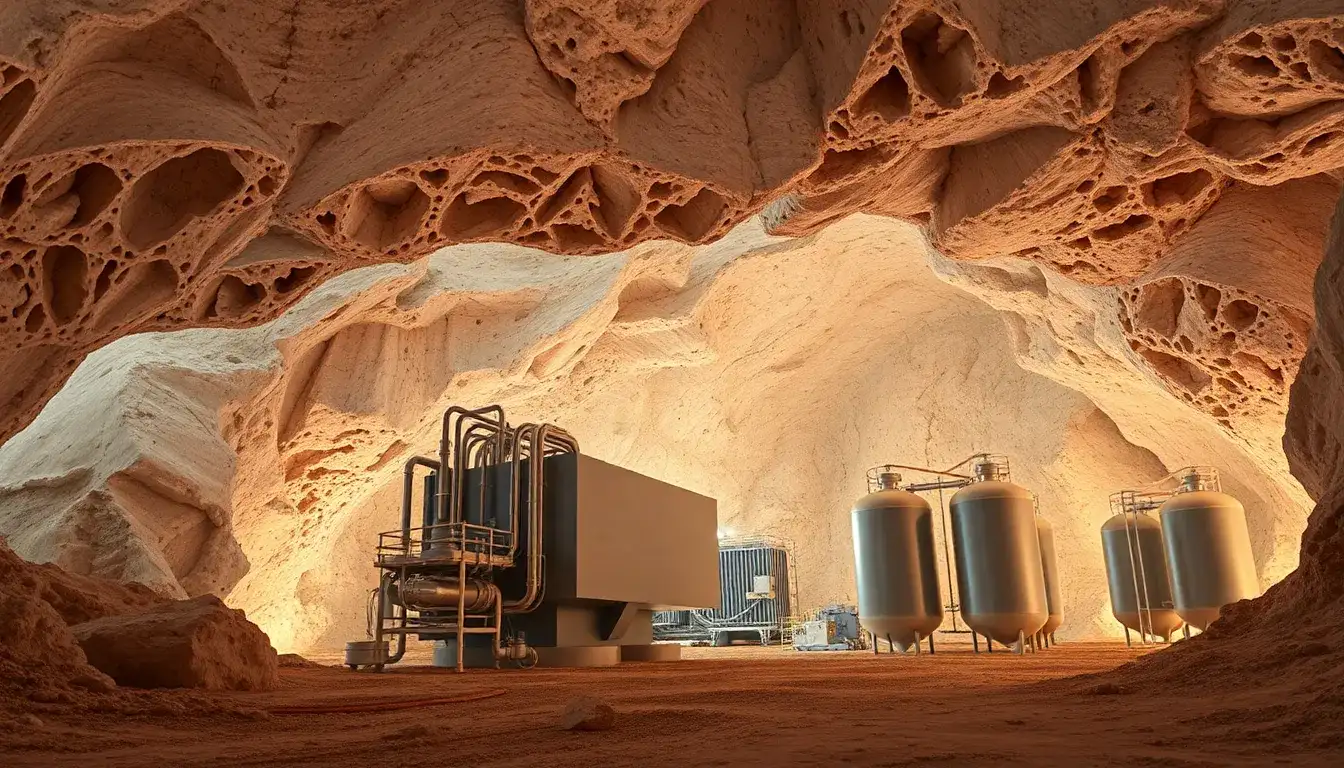
In the Bianyan Town of Feicheng, Shandong Province, the construction of the CPCC Feicheng 2×300MW (Phase I) salt cavern compressed air energy storage project is underway. The project covers an area of 221 acres, surrounded by farmland. Located 1,300 meters underground, there are two modified high-pressure gas storage caverns with a total capacity of 900,000 cubic meters. These storage caverns are connected to the facility through underground gas pipelines.
A project representative explained, “During low electricity demand periods, the power station draws electricity from the grid to drive the compression system, compressing air and storing it underground. It can absorb 770,000 kWh of electricity per hour, and we can also store the large amounts of heat generated during the compression process. When electricity demand peaks, we release the high-pressure air from the underground caverns, using heat exchangers to warm it and drive the generators to produce electricity. This daily cycle of charging and discharging helps to flatten the electricity demand curve and supports the integration of renewable energy.”
Cheng Yongjing, Deputy General Manager and Secretary of the Board of CPCC New Energy Group, noted that the total investment for this project is 3.64 billion yuan, making it the largest demonstration project in the industry in terms of single well diameter and operating pressure. The project is designed to charge for eight hours and can generate electricity at full capacity for six hours, which is the longest duration in the country. It is expected to supply an average annual grid electricity of 1.188 billion kWh, enough to meet the annual electricity needs of 600,000 households, while saving approximately 310,000 tons of standard coal and reducing carbon dioxide emissions by around 600,000 tons each year.
Located in central Shandong, Feicheng is the largest rock salt production base in China, with proven rock salt reserves of 5.22 billion tons. Over the years of mining, 46 pairs of salt caverns have formed, with a total underground cavity area exceeding 20 million cubic meters, and approximately 3 million cubic meters of new caverns are created annually. These previously viewed ecological restoration challenges, the abandoned salt caverns, have transformed into “ideal carriers” for compressed air energy storage due to their unique geological advantages, effectively becoming “super power banks.”
Unique Geological Advantages
“Salt rock has excellent creep properties, automatically sealing tiny cracks under high pressure, ensuring the integrity and stability of the gas storage space. Its ability to withstand pressures of 170 atmospheres and a storage capacity of over 500,000 cubic meters per cavern perfectly meets the demands of large-scale compressed air energy storage,” the project representative explained.
In August of this year, construction officially began on the first injection and production well for the external salt cavern of the CPCC Feicheng 2×300MW (Phase I) project. Cheng Yongjing stated that the project is expected to meet conditions for unit power delivery by the end of 2025 and enter the equipment installation and commissioning phase, with the first unit expected to be connected to the grid by June 2026.
Investment Boom on the Horizon
As a large-scale, long-duration physical energy storage technology, CAES boasts significant advantages, including high storage capacity, long storage periods, relatively low investment costs, and extended lifespans. It is considered one of the most suitable energy storage technology routes for GW (gigawatt) level commercial applications, aside from pumped hydro storage. With recent technological breakthroughs, the CAES sector is witnessing a surge in investment and construction.
In September 2021, the world’s first 10MW advanced compressed air energy storage demonstration power station successfully connected to the grid in Feicheng, marking China’s first commercial CAES plant and signifying the technology’s transition from laboratory to engineering application. Following this, the CAES industry in Feicheng accelerated, with numerous domestic companies investing in construction.
On April 2, 2025, the world’s largest CAES power station, the 350 MW salt cavern storage project in Taian, Shandong, officially commenced operations, establishing Feicheng as a “highland” for compressed air energy storage. During a recent visit to the Feicheng salt cavern storage industrial park, multiple large-scale power station projects were seen in simultaneous development. In addition to CPCC, companies like China Energy Construction and China Storage National Energy are also building salt cavern storage projects, creating a bustling construction scene.
Nationally, the investment enthusiasm for CAES remains high. Currently, aside from utilizing salt caverns, the mainstream forms of compressed air energy storage also include underground caves, mine storage, and above-ground tank storage. Industry data indicates that by 2024, China’s new energy storage installed capacity is expected to reach 42.37 million kilowatts, surpassing a cumulative installed capacity of 73.76 million kilowatts, with the market share of compressed air energy storage continuing to rise. This year, significant projects such as the 1,050MW/630MWh project in Ulanqab, Inner Mongolia, and the cluster of hundred-megawatt projects in Jiuquan, Gansu, have been launched, propelling the industry into the “GW level” development phase.
“In the context of the accelerating global energy transition, compressed air energy storage has entered a golden period of development,” Cheng Yongjing remarked. “Currently, the domestic localization rate of key CAES equipment has surpassed 90%, significantly reducing system construction costs and shortening delivery times.”
A brokerage firm’s analyst mentioned that it is foreseeable that with technological iterations and accumulated engineering experience, compressed air energy storage will become an essential part of China’s long-duration energy storage landscape in the coming years, supporting the establishment of a cleaner, more efficient, and stable new power system.
Dual Support from Policy and Funding
The development of the compressed air energy storage industry is in full swing, with its economic viability drawing particular attention. “With the rapid technological iterations in recent years, China’s 300MW compressed air energy storage technology has matured and is now leading globally,” Cheng Yongjing stated. The localization of core equipment is key to cost reduction; currently, the unit investment cost for CAES ranges from 6,000 to 7,000 yuan per kilowatt, and there is still potential for cost reduction as the localization rate of core equipment increases.
The aforementioned analyst predicts that between 2025 and 2027, the unit investment cost of CAES is expected to continue to decline as a result of scaling effects and technological maturity. According to the “Special Action Plan for the Scaled Construction of New Energy Storage (2025-2027),” it is projected that by 2027, the nationwide new energy storage installed capacity will exceed 180 million kilowatts, with compressed air energy storage receiving both policy and funding support as an important long-duration storage technology.
In terms of business models, capacity-based, energy-based, and ancillary services are currently the main revenue sources for CAES power stations. For instance, the CPCC Feicheng project generates revenue through shared energy leasing, capacity compensation, and peak-shaving capacity markets, while also participating in spot or mid-to-long-term markets to earn revenue from price differentials. Additionally, it can generate income through ancillary services such as peak shaving or frequency modulation.
“CAES projects require significant investment and have long payback periods, which initially dampened enthusiasm among enterprises. Policy support is crucial for breaking this impasse,” a representative from Feicheng’s energy department noted. Shandong Province has taken the lead in establishing measures to support pilot applications of long-duration energy storage, enabling storage projects to participate in the electricity spot market and earn price differentials through “charging during low demand and discharging during peak demand.” They have also set a capacity compensation standard for salt cavern storage that is double that of lithium battery storage for continuous power generation exceeding four hours, effectively enhancing project revenue.
Currently, the National Development and Reform Commission, the National Energy Administration, and various provincial energy departments have been releasing relevant policy documents to support the development of long-duration energy storage. More than 20 provinces have issued specific implementation plans, with Shandong, Gansu, and Inner Mongolia launching diversified policy supports such as electricity spot trading and ancillary services, injecting strong momentum into the industry.
“With policy benefits in place, it is expected that by 2027, the unit investment intensity of compressed air energy storage will decrease by more than 15% from current levels, with the payback period potentially shortening to 8-10 years, significantly enhancing its attractiveness,” the analyst concluded. Compressed air energy storage is poised to play a greater role in new energy bases and grid peak regulation in the future.
Original article by NenPower, If reposted, please credit the source: https://nenpower.com/blog/abandoned-salt-caverns-transform-into-super-batteries-as-compressed-air-energy-storage-attracts-investment-boom/

