

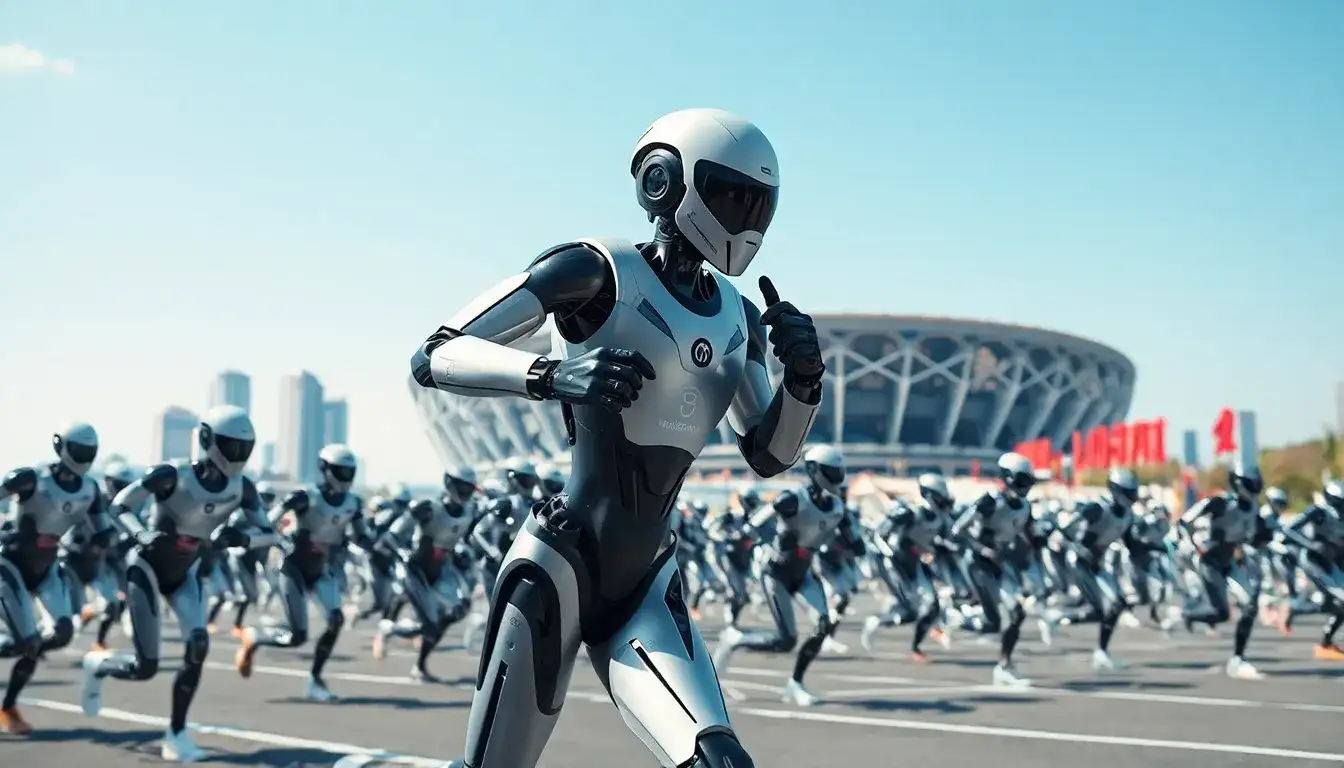
2026 Humanoid Robot Half Marathon Rules Significantly Upgraded
The 2026 Beijing Yizhuang Humanoid Robot Half Marathon is set to take place on April 19. On March 23, Liu Weiliang, Deputy Director of the Municipal Economic and Information Technology Bureau, announced at a press conference that since the registration opened on March 3, the organizing committee has received applications from over 100 teams representing 76 entities, featuring more than 300 humanoid robots from 26 different brands.
Enhanced Competition Rules
The rules for the 2026 half marathon have been thoroughly optimized and upgraded. The updates aim to guide technological breakthroughs through rule innovations, enhance event quality via improved standards, and ensure fair competition through optimized mechanisms. The event’s mascot, a tech-sport version of “Little Yi,” has also been unveiled. It is inspired by the Beijing Yizhuang urban IP “Little Yi” and incorporates core technological elements such as robots, rockets, and autonomous vehicles within the context of marathon sports.
Increased Participation
The 2026 humanoid robot half marathon has garnered significant attention from robot companies, educational institutions, robotics enthusiasts, and the general public. The over 100 participating teams include more than 80 corporate teams and over 20 teams from universities and training camps, showcasing the participation of more than 300 humanoid robots from 26 brands.
“This year’s robot half marathon has seen a remarkable increase in scale, participation, and technical capabilities,” Liu Weiliang stated. The number of participating teams has nearly quintupled, enhancing the event’s influence. Twenty universities have registered through direct applications, collaborations with companies to form joint laboratories, and participation in training camps, reflecting a continuous deepening of industry-academic integration. The 26 robot brands showcased cover the mainstream market, demonstrating the vibrant development of China’s robotics industry from research and development to product innovation.
Focus on Autonomous Navigation
A notable trend among the registered teams for 2026 is the high proportion of autonomous navigation participants, which stands at 38%. Autonomous navigation allows humanoid robots to plan their paths and avoid obstacles independently, eliminating the need for manual remote control and raising the technical bar.
“Last year’s competition primarily used remote control, while this year we have introduced an autonomous navigation mode,” explained Li Quan, Deputy Director of the Beijing Economic-Technological Development Area Management Committee. This change aligns with the rapid development trend of the robotics industry, creating a competition environment more suited to current technological advancements.
Both autonomous navigation and remote control modes will compete on the same track, with mixed timing and unified rankings. Autonomous navigation teams must complete the entire race independently, with manual intervention allowed only in cases of sudden malfunctions or safety hazards, confirmed by a judge. In contrast, remote-controlled robots will be operated by team members from a designated following vehicle.
Technological Advancements
The 2026 event aims to deepen the integration of technological innovation and practical application, enhancing both participant and spectator experiences. All participating robots will be equipped with specialized shoulder badges integrated with Beidou satellite technology, allowing for centimeter-level high precision positioning and real-time trajectory feedback. Additionally, professional security equipment will be set up in the starting area, and dedicated networks will be deployed to ensure a stable and reliable communication environment throughout the event.
For the first time, the event will introduce a “Robot Service Officer,” allowing robots to participate as competitors while also serving as pace officers, performance officers, cleaning officers, and food officers, providing diverse services on-site and showcasing a “human-robot coexistence” experience.
This event represents a significant convergence of technology and sports, providing an opportunity to showcase the allure of the city and promote its culture. The Economic Development Zone will also focus on key application scenarios such as safety and emergency response, creating the “Baturu” robot challenge, which includes 17 obstacle challenges to comprehensively test the robots’ operational stability, agility, and emergency response capabilities.
The 21.0975-kilometer racecourse will feature an upgraded route that seamlessly integrates major urban roads, sections of international automobile racing routes, and ecological park areas, connecting high-tech urban districts with natural environments.
During the event, human and robot competitors will share the stage, vividly interpreting the core concept of “Technology + Sports + Ecology,” allowing every participant and spectator to immerse themselves in the unique urban landscape of Yizhuang, characterized by “hardcore technology and ecological livability.”
Original article by NenPower, If reposted, please credit the source: https://nenpower.com/blog/2026-upgraded-rules-for-humanoid-robot-half-marathon-set-for-april-in-beijing-with-over-300-participants/

