

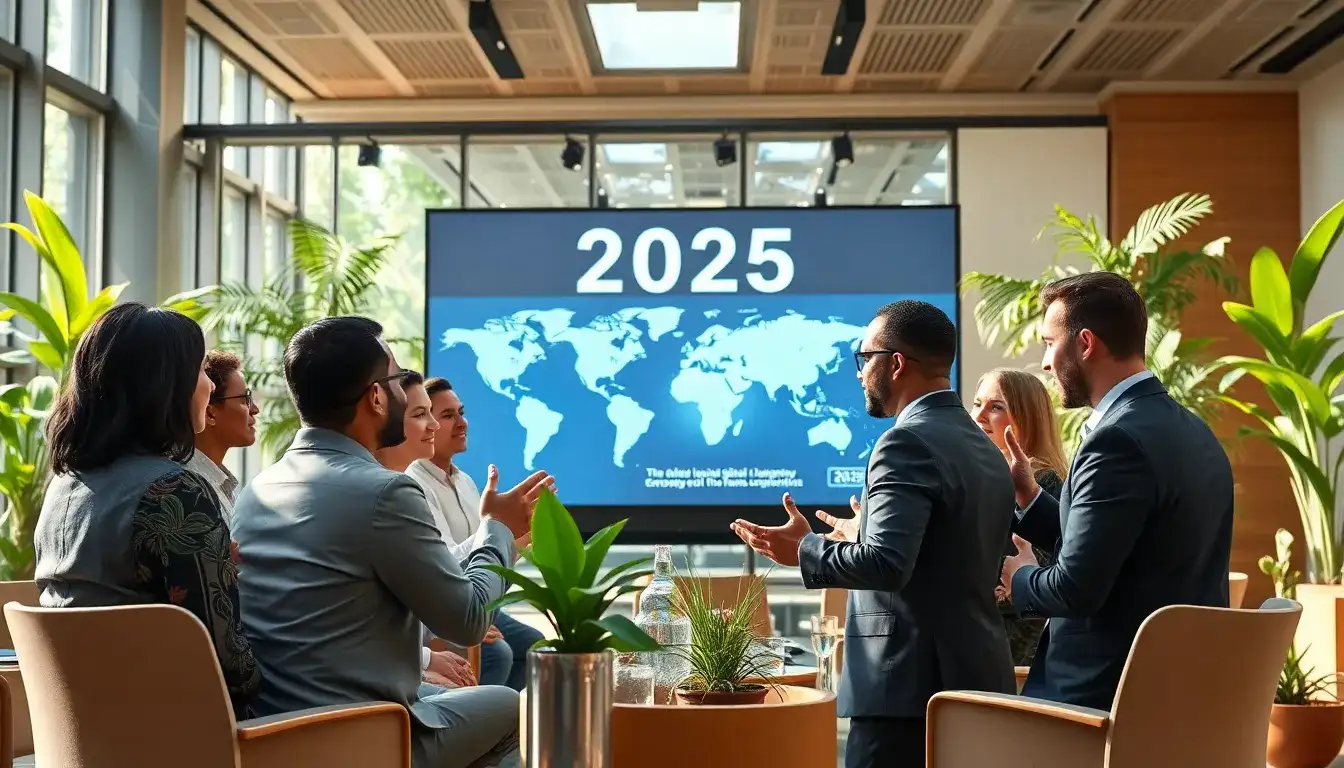
The 2025 Sustainable Global Leaders Conference successfully concluded on October 18. This event, held from October 16 to 18 in the Expo Park of Huangpu District, was approved by the State Council. Centered around the theme “Joining Hands to Address Challenges: Global Action, Innovation, and Sustainable Growth,” the conference brought together global intellect to explore new pathways for sustainable development and inject robust “Chinese momentum” into global sustainable governance.
During the conference, notable speakers included Ban Ki-moon, the eighth Secretary-General of the United Nations and Chairman of the Boao Forum for Asia; Chen Chengchuan, President of the World Federation of Engineering Organizations; Chen Wenhui, former Vice Chairman of the National Social Security Fund Council; and Ding Hui, Secretary of the Discipline Inspection Commission at the Ministry of Ecology and Environment. Additionally, several international dignitaries and representatives from various organizations were in attendance.
The conference was co-hosted by the World Green Design Organization (WGDO) and Sina Group, with the International Financial Reporting Standards Foundation (IFRS Foundation) Beijing office providing support. The event was organized by Sina Finance and the Beijing representative office of the WGDO. Kweichow Moutai served as the global chief strategic partner, while China Construction Bank, Sheneng Group, and Orient Securities were global strategic partners, with Yuyuan Group as an honorary partner.
International Cooperation to Promote Global Prosperity
During the conference, Ban Ki-moon highlighted that over the past five years since the announcement of carbon peaking and carbon neutrality goals, China has made remarkable progress in energy transition. Investment in renewable energy has led to rapid expansions in wind and solar capacity, while also reducing reliance on fossil fuels as hydropower and nuclear energy develop steadily. High-emission industries are accelerating their green upgrades, with green manufacturing and circular economy thriving.
Chen Chengchuan emphasized that global development and prosperity are shared futures. Humanity is currently in a transformative era, defining our future and seeking solutions for tomorrow. Former UN Deputy Secretary-General Janos Pasztor explained that humanity is at a critical historical juncture, facing complex challenges such as climate change, ecological crises, geopolitical tensions, and increasing inequality, which no single nation or actor can address alone.
Marcos Neto, Assistant Secretary-General of the UN Development Programme, noted that global environmental, social, and governance (ESG) related assets are expected to reach $40 trillion by 2030. However, despite extensive commitments and ESG labeling, progress toward sustainable development goals has regressed, with outcomes far from matching the wealth created.
Financial Development Reshaping a Sustainable Future
Chen Wenhui commented on the widely recognized role of technology and innovation in driving sustainable economic and social development. Many current social and economic challenges can be resolved through technological innovation and its industrialization. Ding Hui pointed out that after years of effort, China has become the fastest country in the world to improve air quality.
Wang Naixiang, Chairman of the Beijing Green Exchange, stated that actively responding to climate change is a global consensus. As the world’s largest developing country, China is committed to achieving carbon neutrality in the shortest historical timeframe, facing immense pressure and challenges in reducing carbon intensity throughout the process.
Eric Arthur, head of the UN Environment Programme Finance Initiative, warned that global natural systems are nearing collapse, while political attention is diverted elsewhere. He presented several authoritative reports to highlight the “balance sheet realities that will define this decade.”
Energy Revolution Under the “Dual Carbon” Goals
Sun Xiansheng, President of the International Energy Transition Association, noted that the next five years present opportunities for China’s energy transition through the rapid development of new energy sources, which will optimize the energy industry structure. The challenge lies in how to further optimize this structure and modernize the energy system while ensuring energy security and economic stability. Wang Zhixuan, a member of the National Climate Change Expert Committee, pointed out that policy drivers from the carbon peaking target before 2030 and new NDC goals by 2035 present both opportunities and challenges.
Miao Qing, Chairman of Yingli Group, indicated that China aims to double its installed capacity of new energy to 3600 GW by 2035, up from the current 1700 GW. However, managing the volatility and safety issues in the grid caused by this surge in new energy installations remains a core challenge. David Morris, CEO of the Australia-China Chamber of Commerce Tasmania, emphasized that the core opportunity and challenge in the next five years for China’s energy transition is to reduce dependence on coal, which previously accounted for 50% of global coal consumption.
The Future of Industrial Ecology
Wu Zhonghua, Managing Director of Johnson Controls in Asia, stated that to achieve the carbon peaking and carbon neutrality goals by 2030 and 2060, the manufacturing industry must make breakthroughs in green products. Ma Minglei, Director of the Engineering Research Institute at China State Construction Engineering Corporation, mentioned that the current industrialization in construction is not complete, with the penetration rate of on-site robotics not exceeding 35%, and fully intelligent production lines in housing being rare.
Guan Yu, President of Bosch Comfort Technology Group in China and Southeast Asia, noted that the biggest trends are intelligence and sustainability, which must become core competencies for companies to maintain their competitive edge in the future.
Building a New Paradigm for Green Growth
Mussofi, UNHCR Representative in China, highlighted that the current global displacement issues are intertwined with environmental changes and resource inequities, posing serious challenges to social systems and resilience. Marco Lambertini, former Director-General of WWF, pointed out that economic transformation brings environmental degradation, necessitating advanced technologies to promote social development while protecting and restoring the environment.
Matko Njarvrov, Dean of the Zagreb School of Economics and Management, emphasized that climate change and AI governance transcend national borders, requiring collaboration among nations. David Morris reiterated that the Asia-Pacific region has become a global center for green transformation, with China playing a significant leadership role.
Reconsidering Social Equity
Marco Lambertini stressed the need to recognize the growing scarcity of natural resources and the importance of internalizing environmental risks to discover business opportunities. Diana Joileva, Chief Economist at London’s Inodo Economics, acknowledged the fragmentation of the world but affirmed that cooperation remains essential, with natural, climate, and biodiversity issues benefiting all parties involved.
Guo Peiyuan, UNEP Finance Initiative representative in China, stated that “green + inclusive” has become a hot topic in the industry, with domestic finance exploring the integration of green and inclusive finance, aligning with the direction of “five key financial articles.”
Green Openness and International Cooperation
Khalil Rahman Hashmi, Ambassador of Pakistan to China, mentioned that over 100 developing countries are facing high debt burdens, necessitating various financial tools to alleviate repayment challenges. Additionally, rising protectionism has significantly hindered developing countries’ access to markets and their economic independence.
Haroon Henry, Ambassador of Barbados to China, emphasized the country’s need to take proactive measures to address its challenges. Matko Njarvrov pointed out that climate change and AI governance issues require international collaboration. David Morris reiterated the necessity of increased efforts in the Asia-Pacific region, particularly in China, to expand scale and combat climate change.
Empowerment of Women and Economic Growth
Chen Xi, Managing Director at Boston Consulting Group, highlighted the clear value of women’s empowerment for business development, offering diversified decision-making advantages. Wang Chen, Managing Director of Carrier HVAC North Asia, noted the unique strengths women bring, such as keen insight and resilience, which can provide a competitive edge in complex social and commercial environments.
Wang Qian, General Manager of LinkedIn China, pointed out that by 2035, 70% of jobs may be disrupted by AI and globalization. Jin Yanmin, Senior Vice President of Sony China, remarked on the emergence of numerous outstanding Asian female leaders advocating for goals, emphasizing that diversity and women’s empowerment are essential for innovation and sustainable economic development.
Lu Lunyan, Chief Representative of WWF Switzerland in Beijing, stated that sustainable development reflects on economic models since the Industrial Revolution, emphasizing long-termism, win-win scenarios, and harmonious coexistence with nature, which aligns closely with women’s roles.
Bridging Ideals and Practices
Elko van der Enden, CEO of the European Accounting Alliance, affirmed that Europe has not abandoned sustainable development reporting, but will pursue it with more caution and pragmatism based on dual materiality principles. Zhang Longqiang, Deputy Secretary-General of the China Iron and Steel Association, noted that the steel industry has transitioned from scale leadership to comprehensive green development and technological innovation, continuing to promote green transformation.
Lo Xiaoli, President of Otis China, emphasized that building energy efficiency accounts for 30% of global energy consumption, making it a key area for low-carbon transformation in cities. He Mengning, Chairman of PwC China, mentioned that more companies are focusing on sustainability, leading to improved efficiency and cost control due to differentiated market competition.
Leon Calvert, President of the Economist Group’s B2B business, stated that the transition to a low-carbon economy represents an unprecedented and profound change, reshaping industries and redefining markets. Heidi Bjerg, head of sustainability at the Confederation of Danish Industry in China, shared her journey into ESG practices, noting that understanding the symbiotic relationships between people, nature, and land is crucial.
Integration of Sustainability and Higher Education
Jeffrey Raymond, Executive Vice President of NYU Shanghai, emphasized the importance of external guidance for students, providing opportunities to engage with real-world data. Lei Lili, Vice Dean of the School of Atmospheric Sciences at Nanjing University, supported the deep integration of sustainable development into education, advocating for interdisciplinary collaboration to cultivate talent capable of addressing complex global challenges.
Cheng Shijun, Executive Dean of the Shanghai Advanced Institute of Finance, noted that the institute aims to promote Shanghai as an international financial center, focusing on three interdisciplinary strategic directions: innovative finance, digital finance, and sustainable finance. Chu Chiheng, Vice Dean of the College of Environmental and Resource Sciences at Zhejiang University, stressed the need for universities to enhance students’ practical abilities in addressing real-world sustainable development issues.
The Future of Sustainable Business
David Morris reiterated that the Asia-Pacific region is becoming a global center for green transformation, with China playing a leading role. Jose Odonis, Managing Director of CDP Asia Pacific, emphasized that environmental risks are financial risks, manifesting in supply chain disruptions, resource scarcity, and market volatility. Companies taking action are building a more resilient and competitive economy.
Chen Kai, Chairman of EY China, stated that global ESG development is undergoing profound changes, revealing new trends and dynamics. The shift in international perspectives is pushing ESG compliance from full disclosure to substantive simplification. Ai Ruoxin, CEO of DHL Global Forwarding Greater China, noted that global supply chains are experiencing a significant restructuring, with Chinese companies expanding their focus from traditional markets to emerging regions.
Zeng Song, Chairman of Yida China Holdings, acknowledged the increasing application of AI, which can simplify 80% of work but will not replace humans. Hao Jinyu, President of SGS China, pointed out that the lack of uniform global ESG and carbon footprint standards is a significant challenge, creating trade and regulatory barriers for companies entering foreign markets.
ESG Evaluation Standards and Applications
Deng Yaohua, Chief Representative of GRESB in China, stated that GRESB is a global ESG rating agency with participation from over 3,000 companies across approximately 80 countries. Liu Yifang, Director of the Sustainable Standards Research Center at Central University of Finance and Economics, advocated for a Chinese ESG evaluation system that balances international best practices with China’s unique policy orientations and market expectations.
Shi Mulan, Managing Director of BSI Greater China, emphasized that ESG scoring is complex and presents significant challenges for organizations to navigate. Liu Jingyun, Executive President of the Equator Environmental Assessment Corporation, noted that ESG ratings are not determined by the length of reports but by alignment between the focus areas of companies and rating agencies.
A New Landscape for Global Energy Sustainability
Herbertson, head of Hydrogen Strategy and Cooperation at Qair International, shared insights on green hydrogen’s potential, emphasizing its growing interest. Qian Shengli, Chairman of Shanghai Dingzheng Energy Co., highlighted China’s increasing role in global carbon neutrality and reduction efforts, establishing a strong supply chain and manufacturing capability to provide cost-effective photovoltaic products and wind turbines.
Song Yunbo, Chief Sustainability Officer at GCL Group, noted the multidimensional external challenges companies face, with stringent overseas ESG regulations requiring higher standards for information disclosure. Huang Junzhang, Director of the ESG Department at Hong Kong and China Gas Group, discussed the need to avoid production surges driven solely by demand to prevent overcapacity issues.
Zhang Lili, Vice President of Bureau Veritas, urged companies to view sustainability reports as “health checkups” rather than report cards, emphasizing the importance of transparency and improvement plans. Current “greenwashing” practices, where companies highlight successes while avoiding challenges, can undermine long-term trust.
The Next Frontier of AI Transformation
Matthew Cobb, an honorary professor at the University of Manchester and author of “The Brain’s Transmission,” acknowledged the connection between ecological issues and AI, noting that AI requires substantial energy and resources. Thomas Lamanuskas, Deputy Secretary-General of the International Telecommunication Union, highlighted the critical role of digital technology in climate action amid extreme weather events.
Matko Njarvrov reiterated the need for a unified global AI management framework, emphasizing collaboration among the EU, China, the U.S., and other stakeholders. Edith, Senior Vice President of Perfect World Group, emphasized that AI should serve humanity and not replace it, with a focus on accessibility.
Liang Yu, partner at Genesis Partners, noted that AI exploration is at a pivotal stage, with venture capital supporting early-stage technology companies, despite the challenges of ensuring successful outcomes.
Exploring Robotic Applications
Zhao Yue, founder and CEO of XianGong Intelligent Technology Co., expressed the hope for a diverse robotic world akin to nature, aiming to lower the barriers for defining machine needs in various scenarios. Tang Erying, General Manager of Lingyi Intelligent Manufacturing, discussed the ongoing challenges in adapting industrial robots to specific tasks, necessitating continuous technical breakthroughs by engineers.
Wu Erqi, Vice President of Roborock Technology, stated that integrating robots into households poses significant challenges, with understanding the essence of the problems being more crucial than merely designing robots. Wang Chuang, partner and Senior Vice President at Zhiyuan Robotics, noted that the speed of development in the robotics industry is surpassing expectations, with humanoid robots now capable of complex tasks.
Leadership in Sustainable Development
Yanis Varoufakis, former Greek Finance Minister, remarked that digital technologies driven by algorithms have spawned a new form of capital termed “cloud capital,” fundamentally altering capitalism. Kenneth McFeely, Dean of the Manchester Business School, asserted that ESG and profitability are interlinked, with the pursuit of pure profit contributing to many crises faced today.
Eric Corniel, President of the European Foundation for Management Development, emphasized the need for humanity to reevaluate its lifestyle and business operations in light of challenges such as climate change, resource scarcity, biodiversity loss, and social inequality.
Youth Leaders Shaping the Future
Jiang Chenghong, Senior Partner at Far East Holding Group, noted that the younger generation can leverage past experiences to focus on valuable innovation and sustainable development, free from survival pressures faced by previous generations. Meng Jun, Partnerships Officer at UNHCR, highlighted the agency’s global presence and commitment to promoting sustainable development and humanitarian efforts.
Fang Haoze, President of Ruici Medical Group, shared that East Asia leads globally in physical examination services, with Japan being 20 years ahead and China ranking second in Asia. Mao Sai, committee member of China Chengxin Group, emphasized the pivotal role of young people in AI development, noting their rapid adaptation to new technologies.
Su Dezhong, founder and CEO of You’er Nursery Group, highlighted AI’s potential to enhance childcare quality and safety, while also utilizing AR wearables to monitor caregivers’ well-being during childcare activities.
Original article by NenPower, If reposted, please credit the source: https://nenpower.com/blog/2025-sustainable-global-leaders-conference-concludes-with-keynote-speeches-on-global-cooperation-and-prosperity/

