

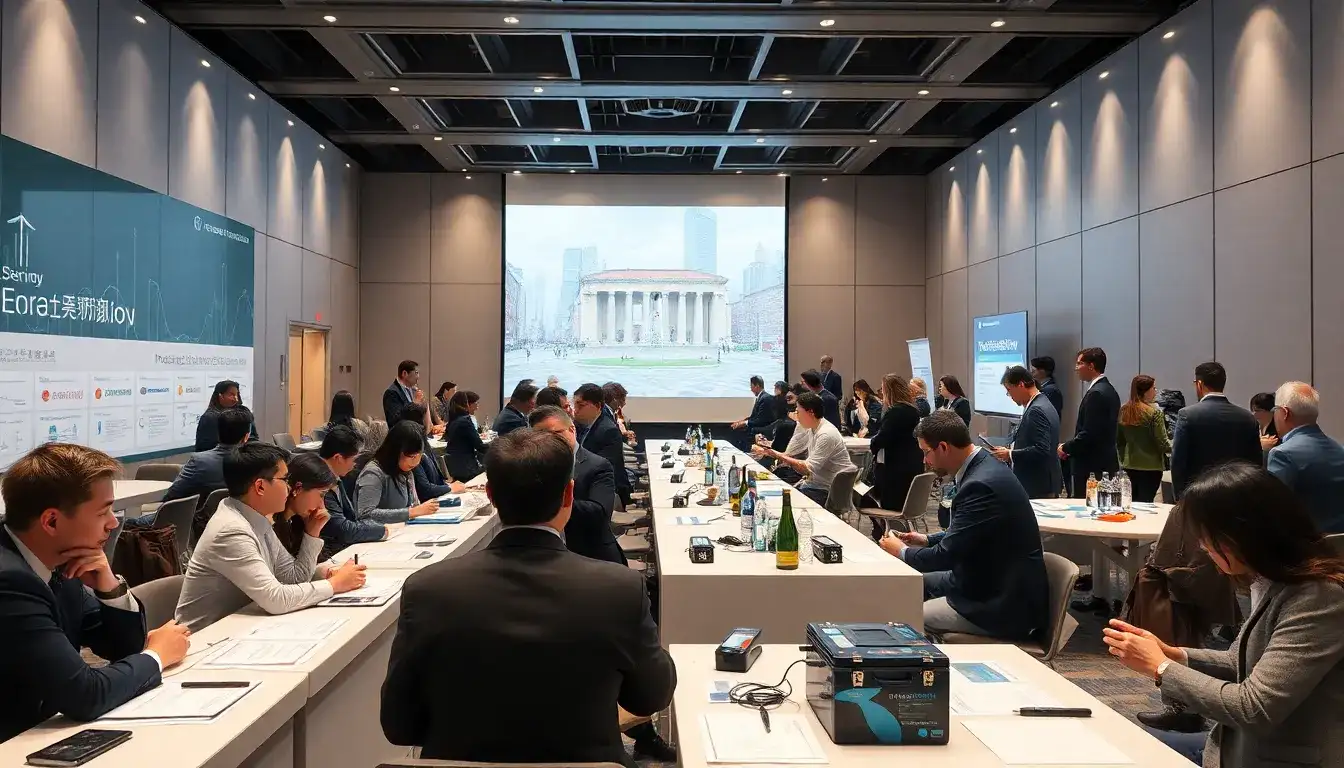
2025 Sodium Ion Battery Industry Chain and Standards Development Forum Opens in Weihai
On September 25, 2025, the Sodium Ion Battery Industry Chain and Standards Development Forum commenced in Weihai, Shandong Province. This forum, marking its fourth edition, aims to gather insights from various sectors including industry, academia, research, and practical applications to enhance the entire value chain from material research and battery manufacturing to market application. The goal is to promote a healthy and orderly transition towards high-quality development within the industry.
The event was organized by the China Electronics Technology Standardization Institute and the Zhongguancun Energy Storage Industry Technology Alliance, with the Weihai Nanhai New District Management Committee serving as the host. The forum attracted over 500 representatives from more than 380 entities, including government departments, research institutions, universities, and related enterprises in the sodium ion battery sector, as well as representatives from applications in electric bicycles, low-speed vehicles, electric ships, energy storage, and emergency power supplies. Additionally, over 16,000 viewers participated online.
Key speakers included Wang Xun, a researcher from the Ministry of Industry and Information Technology, Wang Jianchao, Deputy District Mayor of Weihai’s Wendeng District, Li Yuhong, Director of the Technical Standards Office at the China Civil Aviation Science and Technology Research Institute, Luo Wei, Deputy Director of the Dalian Dangerous Goods Transport Research Center, and Guo Nan, Vice President of the China Electronics Technology Standardization Institute, all of whom delivered opening remarks.
Other notable attendees included Zhou Yan, Deputy Director of the Electronics Information Department of the Shandong Provincial Department of Industry and Information Technology, Dou Litao from the Wuhan Research Institute of China Classification Society, Wang Qingsong from the University of Science and Technology of China, Cao Yuliang from Wuhan University, Long Rongke, Deputy Mayor of Weihai’s Industrial and Information Technology Bureau, and Xu Jianhai, Director of the Industrial and Information Technology Bureau of Wendeng District.
The opening ceremony and the thematic forum sessions were co-hosted by Teng Xinqiang, Deputy Secretary of the Nanhai New District Party Committee, and Liu Wei, Secretary-General of the Zhongguancun Energy Storage Industry Technology Alliance.
Academic Insights on Sodium Ion Batteries
Li Jinghong, an academician at the Chinese Academy of Sciences and a professor at Tsinghua University’s Department of Chemistry, presented a report on High-Power Sodium Ion Batteries. He emphasized that sodium ion batteries represent a significant direction in green energy development. He advocated for leveraging their advantages in high power, excellent low-temperature performance, safety, and cost-effectiveness for applications such as hybrid electric vehicles, uninterruptible power supplies (UPS), frequency modulation energy storage, and as a substitute for lead-acid batteries. He also provided updates on cutting-edge research and industrialization efforts related to high-power sodium ion batteries.
Industry Progress Towards Commercialization
Li Shujun, General Manager of Beijing Zhongke Haina Technology Co., Ltd., discussed the innovation and industrialization practices of sodium ion batteries. He noted that the industry has transitioned from sample validation to commercial implementation. Currently, the focus is shifting from “price disruption” back to “value creation.” He projected that sodium ion batteries will enter a phase of large-scale application by 2026, with significant commercial value that can notably reduce users’ total lifecycle costs. As production scales up and energy density improves, the cost of sodium batteries is expected to halve over the next two to three years, paving the way for sustainable commercialization.
Material Innovations and Continuous Breakthroughs
Deng Liang, an associate researcher at Harbin Institute of Technology, presented findings on the controlled preparation and performance of poly-anion phosphate cathode materials for sodium ion batteries. He explained that poly-anion phosphate materials are particularly suitable for sodium ion batteries due to their stable structure and high safety, making them ideal for applications across a wide temperature range and high-rate scenarios. His team has systematically studied four types of materials, enhancing their electrochemical performance through morphology control, elemental doping, and surface coating. The report stressed that optimizing cathode material performance requires coordination with low/high-temperature electrolyte systems and compatible anodes to achieve long cycles and high-rate charging and discharging.
Safety Comparisons: Sodium vs. Lithium Batteries
Wang Qingsong shared research comparing the safety performance of sodium ion batteries with lithium batteries. The study assessed eight thermal runaway parameters, clarifying the differences in thermal hazards between sodium ion and lithium ion batteries in terms of thermal stability, early warning systems, and severity of thermal runaway. The findings indicated that sodium ion batteries have a lower overall thermal runaway risk compared to ternary lithium batteries and a higher likelihood of early warning, but their severity is greater than that of lithium iron phosphate batteries. Wang emphasized that these conclusions are based on specific material systems, and the safety of sodium battery technologies should be evaluated on a case-by-case basis, providing critical insights for scientifically assessing and enhancing sodium battery safety performance.
Standardization Progress
He Penglin, Deputy Director of the China Electronics Technology Standardization Institute, shared insights on the progress in sodium battery standardization domestically and internationally. He reported that China is steadily advancing sodium ion battery standardization, having issued two national standards, with an additional 11 national and industry standards currently in development. Moreover, four international standards led by China are also in the drafting process. Testing data from 44 companies show that sodium batteries generally outperform lithium batteries in low-temperature performance and safety while complementing lithium batteries in power and energy storage applications, with potential to replace lead-acid batteries across various fields. Several ministries, including the Ministry of Industry and Information Technology and the National Energy Administration, continue to implement policies supporting the development of sodium batteries, positioning them as a key focus in new energy storage.
Key Performance Evaluation Announcements
During the forum, the sixth batch of sodium ion battery evaluation results was announced, recognizing companies that passed evaluations for sodium ion batteries, those participating in low-temperature performance assessments, and those completing 1,000-cycle lifetime evaluations. These evaluations provide crucial support for policymakers, financial investors, client enterprises, media, and the public, focusing on safety performance, low-temperature adaptability, and long cycle life. The evaluations were conducted by the China Electronics Technology Standardization Institute’s SAI Laboratory based on the group standard T/CNESA 1006—2025 General Specifications for Sodium Ion Batteries.
Recognized units in the sixth evaluation included:
- Ningde Times New Energy Technology Co., Ltd.
- Xiamen Haicheng Energy Storage Technology Co., Ltd.
- China Sodium Energy (Yangzhou) Co., Ltd.
Participating units in the first low-temperature performance evaluation included:
- Shanghai Hanhang Technology Co., Ltd.
- Ningde Times New Energy Technology Co., Ltd.
- Zhejiang Tianneng Sodium Battery Technology Co., Ltd.
- Shanxi Huanan Xinneng Technology Co., Ltd.
- Dalian Institute of Chemical Physics, Chinese Academy of Sciences
Units completing the second evaluation for 1,000-cycle life included:
- Hunan Desay Battery Co., Ltd.
During the forum, three representative companies showcased their products: Hanhang Technology presented a comprehensive range of sodium battery materials, cells, and system applications; Yadi shared advancements in sodium battery ecology and vehicle empowerment; and China Sodium Energy discussed efficient applications of sodium batteries in integrated smart energy projects involving source, grid, load, and storage. These achievements collectively advance the industrialization and marketization of sodium batteries.
Recently, the Weihai municipal government has seized opportunities in the new energy sector, actively developing the sodium ion battery industry. A relatively complete industrial cluster for power battery materials has formed, and the under-construction sodium battery material pilot production base will provide strong support for industry development. During the conference, Deputy District Mayor Wang Jianchao provided an overview of the industrial situation in Wendeng District.
Strategic Discussions on Future Technological and Application Innovations
This forum featured a rich agenda, including an opening ceremony, thematic forum, industry chain sub-forum, application sub-forum, standard discussion sessions, and energy storage project inspections. The day before the opening, the Ministry of Industry and Information Technology held the annual meeting of the lithium-ion battery and similar products standard working group for 2025, discussing progress on 13 national and industry standards for sodium batteries, focusing on two international standards and reviewing three national standards.
The Sodium Ion Battery Industry Chain Sub-Forum centered on technological breakthroughs and innovative applications in the sodium battery industry chain. Experts from leading entities such as Wuhan University, the Dalian Institute of Chemical Physics, the Zhongguancun Energy Storage Industry Technology Alliance, and various innovative companies discussed the development progress of mainstream technical routes like Prussian blue and poly-anions, low-cost material development, wide-temperature suitability, and intellectual property risk management, providing deep insights and a communication platform for promoting the maturity and large-scale application of sodium battery technologies.
The Sodium Ion Battery Application Sub-Forum targeted the critical stage of sodium batteries transitioning from technology research to large-scale market application. The forum gathered users, including Datang Group and Guangxi Electric Power, alongside leading companies such as Huana Xinneng, Huayu Sodium Power, Haicheng Energy Storage, Aoguang Sodium Power, Shuangdeng Group, and Xinhai Technology. Key topics included experiences and industrialization cases from cutting-edge areas such as the first 100 MWh sodium energy storage project, two-wheeled vehicles, emergency power supplies for coal mines, and home energy storage. The discussions deeply aligned with end-user demands, showcasing the vast market potential for sodium batteries in specific scenarios due to their safety, low-temperature performance, and cost advantages.
This forum served as a significant platform to discuss the standardization needs and current industrial application status of sodium ion batteries. The sodium ion battery industry is at a pivotal turning point, exhibiting a strong development momentum characterized by clear technological routes, focused application scenarios, supportive standards and policies, and emerging commercialization prospects. Experts unanimously agreed that sodium batteries should leverage their core advantages of high power, low-temperature performance, high safety, and low cost to engage in differentiated competition. The next two to three years will be crucial for sodium batteries to establish a foothold in niche markets and achieve large-scale commercialization.
Original article by NenPower, If reposted, please credit the source: https://nenpower.com/blog/2025-sodium-ion-battery-industry-chain-and-standards-development-forum-opens-in-weihai/

