

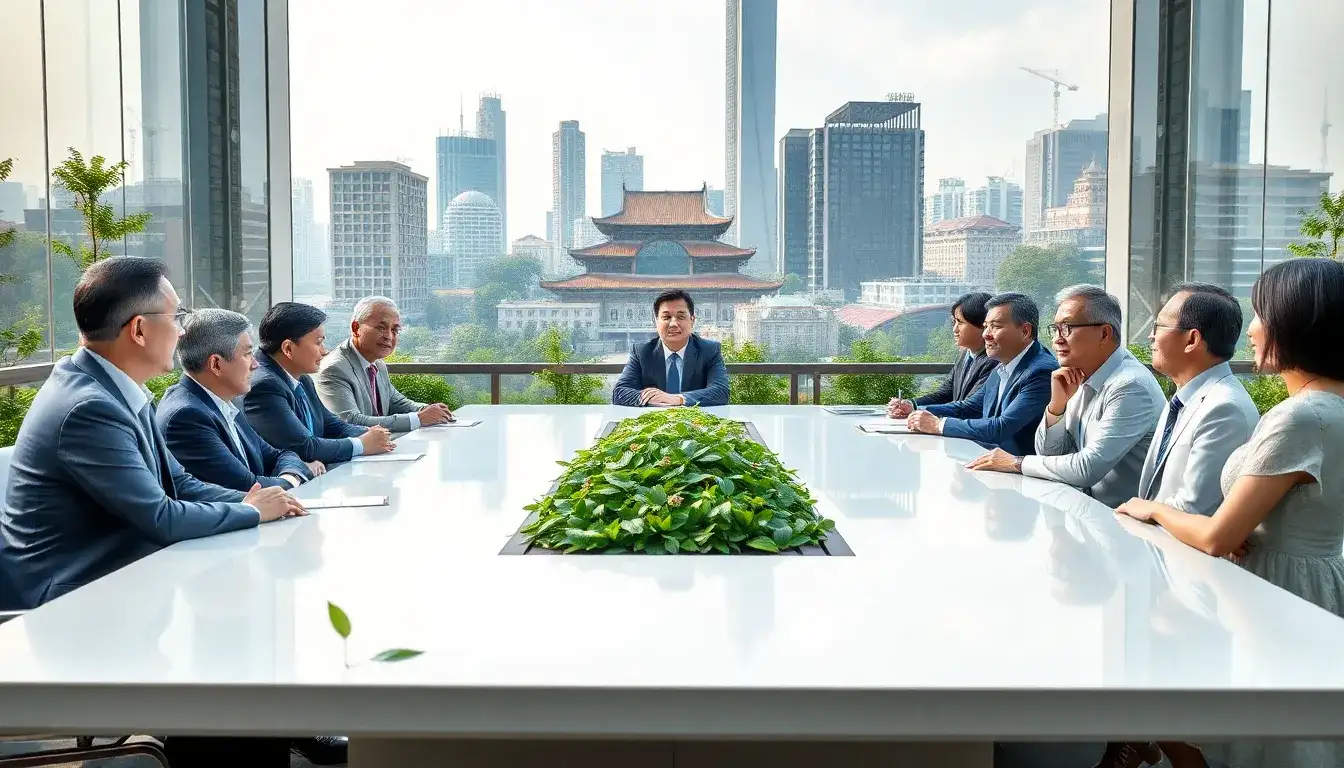
From May 25 to 26, the 2025 Green Value CEO Roundtable Forum took place at the Tianjia Energy base in Nanjing. The event gathered attendees to discuss the theme of “Cross-Border Dialogue, Co-Creating Value, and Leading Transformation.” Participants explored how companies can transition from being “responders” to becoming “systematic solution providers” and “global co-creators of value,” playing a deeper role in the green transformation of cities.
This event was co-hosted by Deep Stone, Tianjia, and Golden Eagle, bringing together numerous guests from international organizations such as the United Nations Framework Convention on Climate Change (UNFCCC) Global Innovation Center, the UN Refugee Agency’s China Office, and Brazil Earth Capital, as well as green technology enterprises, industrial capital, and academic think tanks.
Global Dialogue: Addressing Systemic Challenges in Urban Transformation
During the opening ceremony, Tianjia Chairman Jiang Li reflected on the company’s journey in green development. He noted that as the winner of the 2021 Global Environmental Award Paulson Prize, Tianjia has been motivated to consider the responsibilities of manufacturing enterprises in the era of “dual carbon.” He shared Tianjia’s low-carbon comprehensive solutions tailored to user scenarios, utilizing magnetic levitation host equipment and AGI smart algorithms to significantly enhance energy efficiency. He emphasized, “Companies should focus on their core business amid uncertainty, build trust through openness, and leverage technological innovation to create a green and sustainable ‘moat’ on the path of ESG.”
Wang Shi, founder of Vanke Group and Deep Stone Group, stated, “Carbon neutrality is the only path to the future and cannot be delayed. We must consistently push forward with green transformation, adhering to a clear direction amidst change and continuing to advance.”
Massamba Thioye, Director of the UNFCCC Global Innovation Center, introduced the “City Challenge” global action framework during his speech. He highlighted the need for a goal-oriented approach to drive the integration of technology and finance, providing systematic solutions. He firmly believes that “the best climate and sustainability solutions will emerge from China” and looks forward to the annual city challenge activities, which aim to build a collaboration platform between cities and innovative solutions, encouraging more enterprises to engage in green development and urban strategic upgrades.
Sophie Muller, representative of the UN Refugee Agency in China, called for attention to energy equity, emphasizing the crucial role of private sector involvement and cross-border collaboration.
Marcelo de Andrade, co-founder of Brazil Earth Capital, remarked that China plays a vital role in global climate responses. He believes that Chinese companies possess strong adaptability and execution capabilities, which will likely lead to a more significant role at COP30. He also noted that the forum reflects the ongoing trend of upgrading green international cooperation, expressing hope for deeper collaboration with China on climate finance and technological solutions in the future.
Multi-Theme Salons: Expanding Pathways for Solution Implementation
Focusing on the theme “From Shared Benefits to Shared Wins: Strategic Opportunities for Enterprises in Urban Challenges,” a discussion took place among Massamba Thioye, Jiang Li, and Cao Lei, Deputy General Manager of Beijing Enterprises Water Group. The three guests unanimously agreed that cities are crucial testing grounds for innovative green technologies and business models. Implementing systematic solutions in urban areas not only aids in achieving carbon neutrality but also positions enterprises strategically in the global competition for sustainable development.
During the “Building Energy Resilience and Energy Equity” salon, representatives from the UN Refugee Agency, LONGi Green Energy, Hongzheng Energy Storage, and Jiangsu Grassland Technology Group engaged in discussions about green energy assistance, low-carbon infrastructure development, and localized technology applications, exploring how Chinese companies can provide systematic solutions within South-South cooperation.
The “Exploring Governance and Integration Models for Zero Carbon Parks” salon featured representatives from Brazil Earth Capital, Qatar’s climate negotiation delegation, Huawei, Zhonghuan New Energy, Tuya Smart, and Xinjiang Zhonghuan Oil Forestry, discussing how to create innovation demonstration zones for green parks under international cooperation frameworks.
The “Promoting Globalization of Sustainable Brands” salon concentrated on Sino-European business linkages and the international expansion of green brands. Guests from the German Otto family, the London Development Agency, and LinkedIn Technology engaged in practical dialogues about opportunities for collaboration in commercial real estate, policy mechanisms, and consumer scenarios, offering strategies and investment pathways for Chinese green brands to enter international markets.
Consolidated Initiative Launch: Demonstrating Active Exploration of New Roles
Following the roundtable forum, the conference proceeded to the initiative release and signing segment, showcasing a series of green cooperation projects that reflect the core values and achievements of “Building a Green Future and Deepening Multilateral Cooperation.”
The “Biosphere 3 Green Companions Going Abroad Action – Europe Plan” was officially launched. This initiative, announced by Feng Nan, Chairman of Deep Stone Group and co-founder of Biosphere 3, collaborates with multiple Chinese green pioneer enterprises to utilize global platforms such as the UN Climate Change Conference to promote technology exchange, model output, and industrial collaboration, opening new pathways for green international expansion.
The “Green Nanjing Innovation Action,” initiated by Deep Stone, Tianjia, and Golden Eagle, was also formally announced at the conference. This action will connect global climate governance issues with local Chinese innovations, encompassing urban green vision solicitation, innovation solution incubation, implementation evaluation, and award mechanisms to create replicable and practical models for green development, aiding the global green transition of cities.
At the conference, Gulf Green Technology Company and Qatar Agricultural Plantation Consulting Company signed a cooperation agreement, focusing on green agriculture in the Middle East as a key green expansion project led by Deep Stone Group, aiming to promote the implementation of Chinese green technology in the region’s agricultural systems.
The Wuxi China-Sweden Eco-city dual-carbon demonstration street project was officially launched. Developed by Wuxi Qingshan Green Building Co., LONGi Green Energy, and Jiangsu Grassland Technology Group, the project aims to create a “zero-carbon scenario model street” with demonstrative effects, driven jointly by Deep Stone Group and Jiangsu Grassland Technology Group, a member of Biosphere 3.
Deep Stone Group also signed a memorandum of cooperation with Tianjia Environment. The two parties will collaborate on energy-saving and carbon-reduction technologies at the “Biosphere 3” carbon-neutral experimental park, with Tianjia deploying a magnetic levitation air conditioning system and energy optimization solutions through an energy management contract (EMC) model to enhance system energy efficiency comprehensively. Additionally, “Biosphere 3” will serve as a showcase platform to promote Tianjia products and green technologies, establishing a new collaborative model driven by both “solution + application scenarios.”
The series of initiatives and projects launched comprehensively demonstrate the proactive explorations of Chinese green enterprises in international cooperation and practical implementation, providing a viable “Chinese model” for global green development.
Original article by NenPower, If reposted, please credit the source: https://nenpower.com/blog/2025-green-value-ceo-roundtable-forum-explores-new-ecological-transformations-in-nanjing/

